
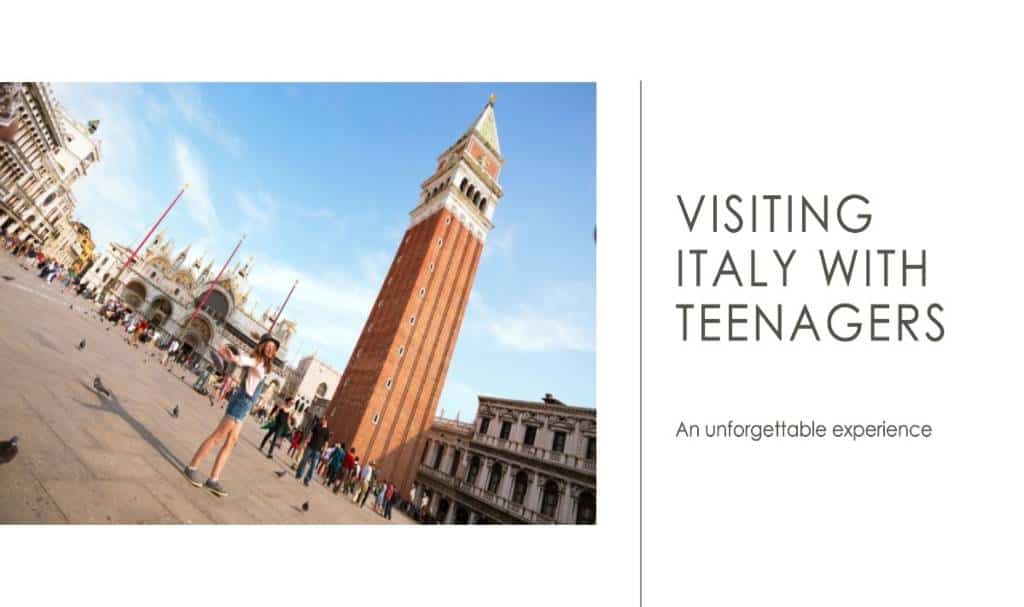
Italy works well with teenagers, mostly because the history is something they can walk around inside. Standing in the Colosseum beats reading about it, and nobody has to be talked into the food. The catch is that it’s easy to overdo it. Three churches before lunch and most teens go quiet, so the trick is mixing the big sights with things they’d pick themselves, like a cooking class, Gardaland or a beach day.
This guide covers the main places to go (Rome, Florence, Venice, Milan, Naples and the Amalfi Coast, Cinque Terre, the lakes, Tuscany, Sicily and Sardinia), what’s worth the time with teens, and the practical changes that catch people out, like the new Trevi Fountain fee and the EU border system.
If you only have a week, pick two or three bases, not six. Italy looks small on a map, but the train time adds up.
The short version:
- Best months are April to June and September to October. August is hot and crowded, and plenty of local businesses close around Ferragosto on 15 August.
- Book ahead for the Colosseum, the Vatican Museums, the Last Supper in Milan, climbing the Leaning Tower and Pompeii. Most of them are capped or sell out.
- Two things have changed recently. Rome now charges €2 to get close to the Trevi Fountain, and the EU border system takes a photo and fingerprints when you arrive.
- For ten days, three or four bases is plenty. Rome, Florence and Venice by train is the easy first trip.
Best places in Italy for teenagers
Here’s how the main places compare, so you can pick your bases.
- Rome is the best first stop, with the Colosseum, the Vatican and the food.
- Naples and Pompeii are the best fit for teens who like their history a bit more real.
- Florence is small and walkable, and works as a base for Pisa and Tuscany.
- Venice is lovely but mostly walking and looking, so a night or two is enough.
- Milan has fashion, football and the Last Supper, and is the gateway to the lakes.
- Lake Garda has Gardaland and the best mix of water sports and theme park.
- Cinque Terre is for walking and swimming, if your teens will do either.
- Sicily has Etna, Greek ruins and beaches, and works best as a trip on its own.
- Sardinia is the beach and watersports one.
Rome with teenagers
Most families start in Rome, and it’s the easiest city to win teens over because so much of it is big and a bit gory. Give it three full days if you can, four if you want to add Pompeii or Ostia Antica. If you only have a day, a guided walking tour hits the main sights.

The big sights
The Colosseum is the one to book ahead. Choose a Colosseum and Ancient Rome tour that includes the third ring and the underground, because the tunnels under the arena floor are the best part. The Roman Forum is right next door and is normally covered by the same ticket, and it’s better with a guide, since on your own it’s mostly broken columns.

The Vatican Museums and Sistine Chapel are the other big booking. Expect queues, and cover your shoulders and knees, because the dress code is enforced at the museums and at St Peter’s Basilica. The Sistine Chapel comes at the end of a very crowded walk, so keep the rest of that day light. If you’d rather do the Vatican and the Colosseum in one hit, there’s a Rome in a day tour, though it makes for a long day.
The Borghese Gallery is the calmer alternative to the Vatican, with Bernini, Caravaggio and Raphael, and entry is by timed slot so book it ahead. Villa Borghese, the park around it, is a handy place to stop between museums.
Two things now cost money. The Pantheon has charged €5 to go in since 2023, and since February 2026 tourists pay €2 to get down to the Trevi Fountain basin (9am to 10pm, free for under 5s). The area in front of the fountain is still free to stand in, so you can see it without paying, you just won’t get the front-row photo. A walking tour of the squares and fountains covers the Trevi Fountain and the Spanish Steps if you’d rather have someone else do the planning.
Ostia Antica, Rome’s old port city, is a short train ride out and has well-preserved ruins with far fewer people than the Forum, so it’s a good half day if the teens have had enough of crowds.
What teens pick for themselves
Gelato is the easy win, with cafés and gelato shops on every corner, and a food tour is a good way to try a bit of everything. In the evening, walk Trastevere and Campo de’ Fiori, which are the livelier parts of the centre. Teens who like the creepy side of Rome can do a crypts, catacombs and ghost tour. The shopping is on Via del Corso and Via dei Condotti, where Via del Corso is the mainstream one and Via dei Condotti is luxury brands, so it’s mostly window shopping at the second.
If the group needs a break from ruins, Rome has theme parks too. Hydromania is a water park on the western edge of the city, about 15 km from the centre, and it runs through the summer. Rainbow MagicLand is the biggest amusement park near Rome, about 60 km out, and Cinecittà World is the cinema-themed park with its own water park inside.
Where to eat in Rome

Pizza and pasta need no selling to teenagers. If someone wants a burger there’s a Hard Rock Cafe, and vegetarians won’t struggle in Rome either.
Where to stay in Rome
Rome is easier if you’re close to a metro stop, because the walking adds up fast in summer. This map shows places to stay across the city.
Booking.comRead more: 10 of the best cities in Europe for the best vacations for families with teenagers.
Naples, Pompeii and the Amalfi Coast with teenagers
Naples is the part of Italy a lot of families skip, which is a shame, because Pompeii is the one ancient site many teens actually get into. It’s a whole town stopped in 79 AD, with streets, shops and houses, not just a few columns.
Pompeii has tightened its rules. Since March 2026 entry is capped at 20,000 people a day, tickets carry your name and you need photo ID that matches, and between mid-March and mid-October you pick a time slot. In July and August book at least a few days ahead, and go in the morning if you can, because the afternoon allocation is smaller and the heat is worse. Mount Vesuvius is the usual add-on, so check the national park’s current rules for crater access before you plan around it. Naples itself is the home of pizza, so lunch is sorted.
The Amalfi Coast
There’s no train along the Amalfi Coast itself. The usual route is the high-speed train from Rome to Naples (just over an hour), then the Circumvesuviana to Sorrento or a ferry or bus along the coast.
Positano and Amalfi are the headline towns. The Cathedral of Sant’Andrea in Amalfi is worth a look, and a boat is the easiest way to see the coast in summer, because the road is narrow and slow. If you’d rather not drive it yourself, there’s a drive along the coast from Sorrento and a private tour. Sorrento is a practical base, with plenty of shops and restaurants, and the ferries and trains are close.
The Sentiero degli Dei (Path of the Gods) is the famous walk above the coast. It’s a good first mountain walk for teens, but it’s longer than it looks and there are a lot of steps, so go early and take water. The coast fills up in summer, so sort the base early. Here are places to stay.
Florence, Pisa and Tuscany with teenagers
Florence

Florence is small enough to walk and packed with art, and the trick is not trying to see all of it. The two big ones are the Uffizi Gallery and the Accademia Gallery, which has Michelangelo’s David. Unless your teens like art, pick one. The Accademia is the shorter visit and has the one statue everyone has heard of.
Ponte Vecchio is the bridge with the jewellers’ shops on it, and it’s best crossed early before it fills up. Cascine Park is the big park by the Arno if everyone needs a break, the San Lorenzo leather market is where teens will want to shop, and a cooking class is a good wet-weather option.
Pisa
Pisa works as a half day from Florence, about an hour by train. The Leaning Tower is free to look at from outside, and everyone takes the photo of holding it up, which is worth doing for the laugh.
Climbing it is different. You need a timed ticket (around €20), the climb is 294 steps, the minimum age is 8, and visitors under 18 need to go up with an adult. It sells out in summer, so book ahead. The cathedral next to it is free but also needs a timed ticket. If you want lunch, there’s a Pisa food tour.
Tuscany
Tuscany is better with a plan. Without a car the easiest way is a day trip from Florence. A Chianti and Siena day trip is the standard one, there’s a Siena, San Gimignano and Pisa version if you want to cover more in a day, and a Val d’Orcia tour for Montalcino, Pienza and Montepulciano. Another option is a San Gimignano tour with a farm lunch. A few of these are built around wine tastings, which teens will sit through for the lunch, so look for ones that also visit a town.
For something more active, there’s an e-bike vineyard ride from Florence and a horse ride from Siena.
Near the coast, Cavallino Matto is Tuscany’s biggest amusement park, with roller coasters in a pine forest and a beach nearby. It’s south of Livorno, so it’s an easier day from Pisa than from Florence. The nearest station is Donoratico, about 3 km away, and the park is seasonal, so check opening dates.
Where to stay in Tuscany
The best bases with teenagers are Florence, Siena, Lucca, the Chianti region and the Maremma region. Florence and Siena suit city and art trips, Lucca is small and walkable, and Chianti and Maremma work better if you have a car.
Venice with teenagers
Venice is the most photographed place in Italy and the easiest one to overdo. It’s mostly walking and looking, so a night or two is plenty for most teens.
St Mark’s Basilica and the Doge’s Palace are the two big sights, and a gondola ride is the thing everyone pictures. It’s pricey, so decide whether you really want it. The Rialto Bridge and market are on the way to most things, the Mercerie is the main shopping street, and teens who like crafts can make a carnival mask. For a beach day, the Lido is the nearest option.
The Venice access fee
Venice charges day visitors an access fee on peak days. In 2026 that was 60 days between early April and late July, from 8.30am to 4pm, and it applies to anyone aged 14 and over, so your teens pay too. It’s €5 if you register and pay at least four days ahead and up to €10 if you leave it late, and you need the QR code on your phone. Under-14s are exempt, and so are people staying overnight in the municipality, though you still register for the exemption on fee days. The city is talking about raising the fee to as much as €30 and extending it from 2027, so check the official site (cda.ve.it) before you go.
Staying at least a night is the simplest way around it, and it’s a better way to see Venice anyway. If you’re deciding where to sleep, start with places to stay in Venice.
Not sure what your teen will need on holiday? Click here to get all the top sellers for your travelling teens.
Milan with teenagers
Milan is more about fashion, football and a very good cathedral than ruins, so a day or two is enough before heading out to the lakes.

The Duomo is the main sight, and a Milan in one day tour covers it with a few other stops. The Sforza Castle holds several museums, and the Last Supper is the other big booking, because Leonardo’s painting is only seen in small timed groups and it sells out well ahead. There’s a Last Supper and Sforza Castle tour and a Leonardo and the Last Supper tour. The Galleria Vittorio Emanuele II is the glass-roofed shopping arcade next to the Duomo, and Parco Sempione sits behind the castle.
Navigli is the canal district, and the Navigli walking experience is a good way into it, with bars and restaurants along the water that are better from late afternoon. If anyone is a football fan, see if there’s a match at San Siro while you’re there. A hotel near a metro stop saves a lot of walking, and places to stay in Milan are easy to compare.
Lake Garda, Gardaland and the Italian lakes
Garda has the theme park, Como is the postcard one, and Maggiore is the third lake people forget about. Garda is the best fit with teens.

Gardaland is on the shore of Lake Garda and is one of Italy’s biggest theme parks, with Blue Tornado and Raptor for the coaster fans. Queues are the main cost, so go early and plan a full day. There’s a Gardaland day trip from the Venice area if you’re coming from that side.
On the water, Lake Garda has boat tours, windsurfing, kitesurfing and kayaking. The medieval town of Sirmione has Roman ruins and thermal baths and is the one village worth making time for. There’s also a Dolomites day trip from Lake Garda for something bigger.

Lake Como and Lake Maggiore
Lake Como is an easy day trip from Milan, with Como and Bellagio as the main towns and villas and gardens along the shore. Lake Maggiore works the same way. On any of the lakes, a boat tour is the lazy way to see the villages, and a picnic makes it better.
Cinque Terre with teenagers
Cinque Terre is five small villages on a cliff coast, car-free and reached by train, and it’s busy. It works best with teens if there’s a swim or a hike in the day, not just wandering around five similar-looking villages.

The trains between villages are the easy way around. The famous Blue Trail (Sentiero Azzurro) along the coast needs a Cinque Terre Card in the main season, while the high trails and the paths up to the sanctuaries are free and don’t. Sections of the coastal path close after landslides and for repairs, so check the national park’s website on the morning you plan to walk.
The Via dell’Amore, the short walk between Riomaggiore and Manarola, reopened in August 2024 after 12 years closed. It’s one way only (Riomaggiore to Manarola), you book a timed slot, and from March 2026 it’s included in the card rather than being a separate ticket, though it’s worth confirming on the park site when you book.
For something other than walking, there’s a kayaking trip from Monterosso and private trekking tours. Monterosso has the proper beach of the five. For lunch, Ristorante Belforte is in Vernazza. For more active family trips, see our family activity holiday guide.
Sicily with teenagers
Sicily is big and the distances are long, so pick one corner instead of trying to do the island. The east is the easiest for teens, with Mount Etna, Catania, Syracuse and Taormina all close together.
Syracuse has Greek and Roman ruins and the old island of Ortigia, and Catania is a lively, slightly chaotic city at the foot of Etna. Etna itself is the obvious one for teens, since it’s an active volcano, and what you can do depends on the day’s activity, so book a guided trip and check the rules for the day. The Valley of the Temples at Agrigento is one of the best-preserved Greek sites anywhere, though it’s a drive across the island from the east.
If your teens would rather be active, there’s an e-bike tour in Madonie Natural Park, and Etnaland is the theme park near Catania, with a water park alongside the rides.
Where to stay in Sicily
Palermo, Taormina, Syracuse, the Aeolian Islands and Agrigento are the usual bases, and there are family villas in Sicily if you want more space.
Sardinia with teenagers
Sardinia is the beach and water one. The sand is good, the water is clear, and teens can sail, snorkel, kayak or hike in the same week. Our guide to the best beaches in Sardinia for families has the beach side covered.

Surfing is the one thing to manage expectations on. The season is October to April, and in summer the waves are mostly flat. Capo Mannu on the west coast is the famous break and it’s for experienced surfers only. In summer, teens are better off with windsurfing and kitesurfing at Porto Pollo, which is also busy in July and August, or the flat water at Putzu Idu, which has a school on the beach. If you do want a lesson in the right season, there’s a private surf experience with a certified guide, and Carlo Sanneris Surf Coaching is another option, so check recent reviews.

On the water, the La Maddalena archipelago is the best for sailing and snorkelling, and you can go by private sailboat too. Kayakers usually start on the Temo River at Bosa.
On land, the coastal path between Cala Luna and Cala Gonone is a popular walk, there are guided treks into the Gola Su Gorropu canyon, and the Capo Caccia cliffs and Neptune’s Grotto near Alghero are worth a boat trip. For a base, see places to stay in Sardinia.
Hiking in the Italian Alps and Dolomites
If the trip is mostly cities, a couple of days in the mountains helps. The Dolomites around Cortina d’Ampezzo are the classic, and there are guided options like this Dolomites hiking tour. The multi-day Alta Via routes are a big commitment, so most families do better with day walks and a lunch stop at a mountain hut (rifugio). Gran Paradiso National Park, on the Aosta Valley and Piedmont border, has easier walks with glaciers, alpine lakes and wildlife. In winter the same region is one of Europe’s main ski areas.

A 10 day Italy route for teenagers
This is the first-trip route we’d suggest, and it works by train with a couple of hours between each stop. Days 1 to 4 are Rome, with the Colosseum and the Vatican on the first two days and Pompeii or Ostia Antica as a day trip on the fourth. Days 5 to 7 are Florence, with Pisa as a half day. Days 8 and 9 are Venice, and day 10 is Milan before you fly home.
If your teens would rather have a beach and a walk than a canal city, swap Venice for Cinque Terre. With only a week, drop Milan and cut Venice to one night, or skip it. Fly into Rome and out of Milan or Venice so you’re not doubling back.
Planning a trip with teens? All the best suitcases for teens are reviewed here.
Planning Italy with teenagers
When to go
April to June and September to October are the sweet spot, with warm days and smaller crowds. July and August are hot, especially in Rome, Florence and the south, and the cities are packed. Many local businesses close around Ferragosto on 15 August. The Alps and Dolomites are at their best in summer, and the Cinque Terre Card season runs from about mid-March to early November.
Getting around Italy

Trains are the easiest way between the big cities. The high-speed trains are fast and cheapest when booked ahead, and some train types have family fares for children up to 17, so check the details when you book. Driving is harder than it looks, because most historic centres are ZTL zones, restricted areas where cameras fine you for driving in, and parking is hard. Transport strikes happen often and are normally announced in advance, so check before a travel day.
Getting to Italy
Rome, Milan and Venice are the main entry points for most trips, and Naples is handy for the south. You can compare flights to Italy here. Coming from elsewhere in Europe, there are direct trains into northern Italy from cities including Paris, Geneva, Vienna and Munich, so check the route, and FlixBus runs long-distance routes from Central and Eastern Europe.
Things that catch families out
- Cover your shoulders and knees in churches, including St Peter’s and the Vatican Museums.
- Pickpockets work the crowds in Rome, Florence, Milan and Naples, especially on the metro and around the big sights, so keep phones and wallets in front pockets.
- Many hotels charge a city tourist tax per person per night, paid at the hotel, and plenty of restaurants add a cover charge per person.
- Rome has free drinking fountains (nasoni) all over the centre, so bring a refillable bottle.
- Restaurants often start dinner service around 7.30pm or later, which is late for some teens, so snacks help.
What might not land with teens
Worth being realistic. Churches and museums where everything is behind glass with long text panels go down badly after the second one, and a long queue in the sun can wipe out a morning. What works is one big sight in the morning and something looser after lunch, like a gelato, a walk or a pool.
Italy for international visitors
Sort out travel insurance as soon as you’ve booked. Get a quote through Insurance Masters before you go. Italy uses the euro, and spending from your home account can rack up fees, so a travel card like Revolut loaded with euros is the cheaper way.
Most visitors from the US, UK, Canada and Australia don’t need a visa for up to 90 days in any 180, but your passport should be valid for at least three months after you leave and issued within the last 10 years. The EU’s Entry/Exit System started in October 2025 and has been fully running since April 2026. It takes a photo and fingerprints at the border (under 12s aren’t fingerprinted) instead of stamping your passport, and there were long queues at some big airports last summer, so allow extra time on arrival. ETIAS, the €20 travel authorisation, is announced but isn’t running and has no confirmed start date as of October 2026. Don’t pay a website offering to process one.
To stay connected, buy a SIM card or a virtual eSIM before you leave, or rent a pocket modem you can pick up at the airport or your hotel.
Questions families ask about Italy
Is Italy good for teenagers?
Yes, if you pace it. The sights are big enough to hold their attention, the food is easy, and there are things like Gardaland, Pompeii and the beaches in between. It goes wrong when every day is churches and museums.
How many days do you need?
Seven days covers Rome and Florence properly. Ten adds Venice and Milan, or a beach stop. Pick three or four bases at most.
What is the best time to visit with teenagers?
April to June and September to October. August is hot and crowded.
What do we need to book ahead?
The Colosseum, the Vatican Museums, the Borghese Gallery, the Last Supper in Milan, the Leaning Tower climb, Pompeii (named tickets and timed slots) and the Via dell’Amore slot at Cinque Terre. Venice’s access fee is cheaper if you pay at least four days ahead.
Do teenagers pay the Venice fee?
Anyone aged 14 or over pays on fee days if they’re visiting for the day, so your teens do. Under-14s are exempt.
Is Italy safe for teenagers?
Generally yes. The main problem is pickpocketing in crowded tourist areas, so keep valuables in front pockets and agree a meeting point in case anyone gets separated.
Do we need a visa?
Most visitors from the US, UK, Canada and Australia don’t need one for stays up to 90 days. The passport rules, the Entry/Exit System and ETIAS are covered in the international visitors section above.
If you’re stuck on where to start, Rome, Florence and Venice by train is the easy first trip, and the rest of this list makes a good second one.
More destination guides are below.
More travel inspiration for your trip to Europe

34 best places to stay in Paris with teenagers

Los Angeles with teenagers – epic vacation ideas
